

Salt!
Thanks to Elizabeth Browne for the prompt to write about salt.

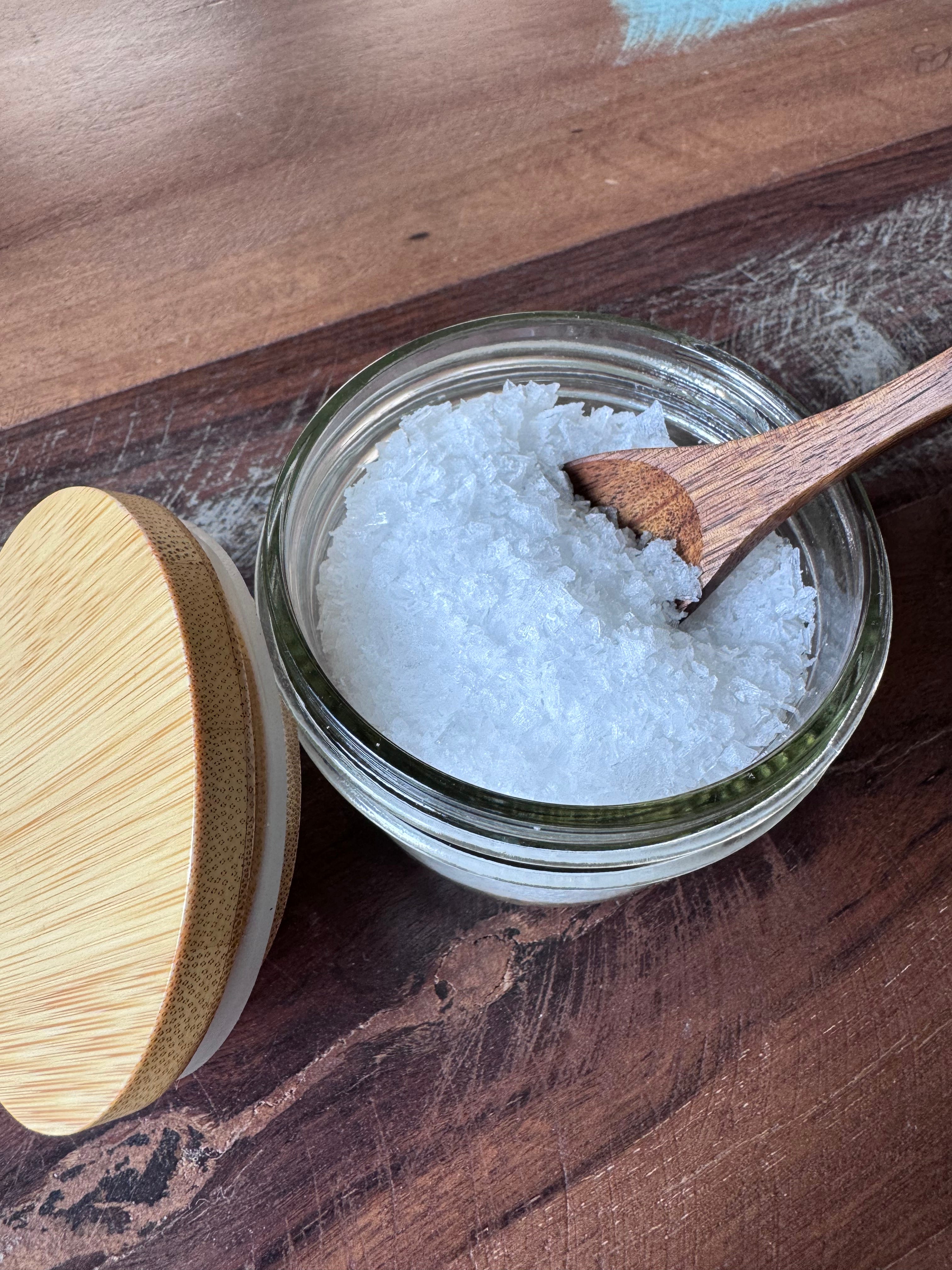
“I love salt. I used to devour salted pumpkin seeds as a kid, and also sprinkled salt on a saucer and licked it when my mother went to pick my father up at the train before dinner.” Elizabeth Browne
Salt. SALT! If ever I crave a food, it is something crunchy, with salt.
Salt is the one substance that has been simultaneously essential to civilization and used to destroy it—and we've spent the last fifty years being afraid of it for mostly bad reasons.
In your body, each cell has a mechanism called the sodium-potassium pump. In the most basic terms, the motion of the elements in and out of your cells produces a gradient that is both electrical and chemical and allows muscle and nerve to function, along with quite a few other things.
So it would seem that salt—sodium chloride—one half of the pump, would be essential. Yes. Yes it is.
Why is salt then restricted for many due to moderate blood pressure or kidney problems? Well, salt attracts water, so if you are puffy, it can make you more puffy. This is sometimes not optimal. Do all salts do this? Yes . . . but . . .
The studies that showed salt intake should be restricted were performed on highly processed foods, which by default contain large amounts of salt. Salting your food at the table rarely leads to this increase.
Also, bodies respond differently to different amounts. Some people are resistant to large quantities and never show a sodium increase. Too little salt in your diet causes problems too. Medical emergencies related to salt directly always stem from too little, not too much. Too much is only going to cause significant problems if you already have a disease that salt will make worse. Salt causes no disease on its own.
So, the medical community has backed off of its global low-salt stance and now recommends it for those with disease specific needs.
My favorite salt for both cooking and eating is Maldon salt. It’s been harvested in Maldon, Essex, England, since the 1000s. Like a thousand years. The Maldon Crystal Salt Company is family owned and has been since 1922. In the Domesday Book, it lists the Maldon area as having 45 salt pans, or areas that could be harvested—meaning sea water boiled to extract the salt.
Maldon salt has a distinctive pyramidal shape, big crystals, and a phenomenal taste.
I found Maldon salt after I read the book Salt Fat Acid Heat.
I eat it plain. I sprinkle it on my ribeye as it cooks and sometimes season it before cooking, I put it in cottage cheese, I eat it on salads.
It’s been a preservation method since long before refrigeration, before chemical preservatives. So when processed food includes salt, some of that function is taste, some is preservation.
Salt doesn’t just taste good, and occupy the space of ESSENTIAL in your body. It’s also been the nexus of social disobedience, and cultural meanings. It will also make the soil barren if used in large quantities, so salting the earth was an easy way (easy but expensive) for armies to affect the enemy population’s ability to grow food. It’s been used as a WEAPON.
Salt was weaponized by Gandhi into civil disobedience because it was an item that was essential to life in a readily identifiable physical form, and had been taxed by the British Empire. In 1930, between March 12 and April 6, Gandhi and 78 followers walked 240 miles from his ashram to the village of Dandi on the Gujarat coast. The act of picking up a small lump of natural salt at the seashore was illegal.
His action sparked the civil unrest that led to mass arrests and more civil marches. His simple action is credited with starting the momentum of change that resulted in Indian independence in 1947. A tax on the substance a human body requires, in effect since 1882, was the proverbial last straw.
Now, instead of civil unrest, salt is actually a tourist commodity. At least 5 states in the United States mine salt from the earth. Countries that mine extensively are China, India, Germany, Canada, Australia, Pakistan (Himalayan pink salt), Romania, and Poland. Those 8 countries plus the USA mine over half the salt produced in the world. We eat a lot of salt.
In researching this, I discovered that you can actually tour salt mines in many countries. I did not know this.
Next time you salt your steak, or stick your finger in salt to eat it plain, think of this: Someone from thousands of years ago would recognize very little of their world in our modern culture, but they would recognize salt.
Blessings,
Jo
Well I didn't know all that...I got the visual of Ghandi picking up salt in defiance.
Very interesting and informative. Darn, I wish I had some salted popcorn to eat while I read this.